
If you're reading this at 3 AM because the pain woke you up again...
If you know exactly which kitchen counter, which grocery cart, which railing to lean over just to take the pressure off for a moment...
If you've canceled more dinners than you've attended in the last year because you can't sit through a meal anymore...
If you walk into every room and scan for the nearest chair before you notice anything else...
I'm writing this for you.
Because I was you.
Two years ago, I was planning my own funeral.
Not literally.
But I'd started doing that thing people do when they've given up. Giving away the books. Telling my kids where the important papers were. Canceling the trip to Scotland my husband and I had been saving for since 2008.
I was 66 years old.
My surgeon had just told me — very kindly, very professionally — that my second surgery probably wouldn't work either.
And I believed him.
Because by that point, I'd tried everything.
And nothing had worked.

My stenosis started in 2014.
I was 55. A librarian. On my feet 8 hours a day, shelving books, helping children find their next adventure.
I loved it.
Then one Tuesday morning I couldn't stand up from my chair.
Just couldn't.
My legs had gone numb from the knees down. My lower back felt like someone had poured concrete into it overnight.
My husband drove me to urgent care. They sent me for an MRI.
"Moderate-to-severe spinal stenosis at L4-L5, L5-S1."
I'd never heard the words before.
I learned them fast.
What followed was 9 years of what I now call the parade.
Everyone with a white coat got their turn.
Physical therapy: 12 weeks, three times a week. I cried after most sessions. The therapist was kind. The exercises were correct. My back got worse anyway. She said "some people just don't respond." I was one of them.
Chiropractor: Twice a week for six months. He was lovely. He'd crack my back and I'd feel wonderful for about 90 minutes. By the time I got home the pain was back. I stopped going when I did the math — I'd spent $3,800 for about 40 hours of relief.
Pain management: Three epidural injections over 18 months. The first one was incredible. I had 6 weeks of relief. The second gave me 3 weeks. The third did nothing. They wanted to try a fourth. I said no.
Gabapentin: Made me foggy. Made me gain 15 pounds. Made me feel like I wasn't myself. I still had pain. Just pain plus fog.
Tylenol, Aleve, whatever was in the medicine cabinet: You know exactly what I mean.
A $400 TENS unit my daughter ordered from Amazon: I felt a buzzing sensation on my skin. Nothing deeper. I used it for two weeks and put it in the drawer.
A copper-lined back brace: Made my back sweat. Made my pain worse when I took it off because my muscles had gotten lazy wearing it.
Inversion table: Terrifying. Hurt my hips. Did nothing for my back.
Yoga: Every morning for a year. I got more flexible everywhere except where I needed it.
By 2021, I was scheduled for fusion surgery.
Surgery was my last resort.
My surgeon — a good man, I still believe that — told me it had a "very good chance" of resolving the pain.
I had the surgery in March 2022.
I woke up hopeful.
For about 3 months.

It was a Saturday in July.
5 months post-op.
I'd been sleeping in the guest room because I couldn't find a comfortable position in our bed.
I tried to sit up.
I couldn't.
Same concrete feeling in my back. Same numbness creeping down my leg. Same panic I'd felt that Tuesday morning in 2014.
I sat on the edge of that bed and I cried like I hadn't cried in years.
Not from the pain.
From the realization.
I had tried everything.
And I was exactly where I started.
Actually — no. I was worse.
Because now I'd had surgery. Which meant scar tissue. Hardware. Fewer options going forward. And a surgeon who, when I went back for my 6-month follow-up, said: "Margaret, sometimes these things don't give us the result we hoped for. This may be your new normal."
My new normal.
At 66.
That's when I started giving the books away.
My daughter-in-law Rebecca is a nurse.
She's worked in post-surgical orthopedic recovery for 14 years.
Two Thanksgivings ago, she sat with me at the kitchen table after everyone else had gone to bed and asked me a question I'd never been asked before.
"Mom. Has anyone, in the last 9 years, ever tested whether your multifidus is firing?"
I didn't know what she meant.
I'd never heard the word.
In nine years.
Across a dozen specialists. Through two MRIs. Through physical therapy. Through a surgery where they opened up my spine.
Nobody had mentioned the multifidus.
Not once.
Rebecca explained it to me that night. What I'm about to tell you took her 20 minutes around my kitchen table. I'm going to try to tell it to you the same way.
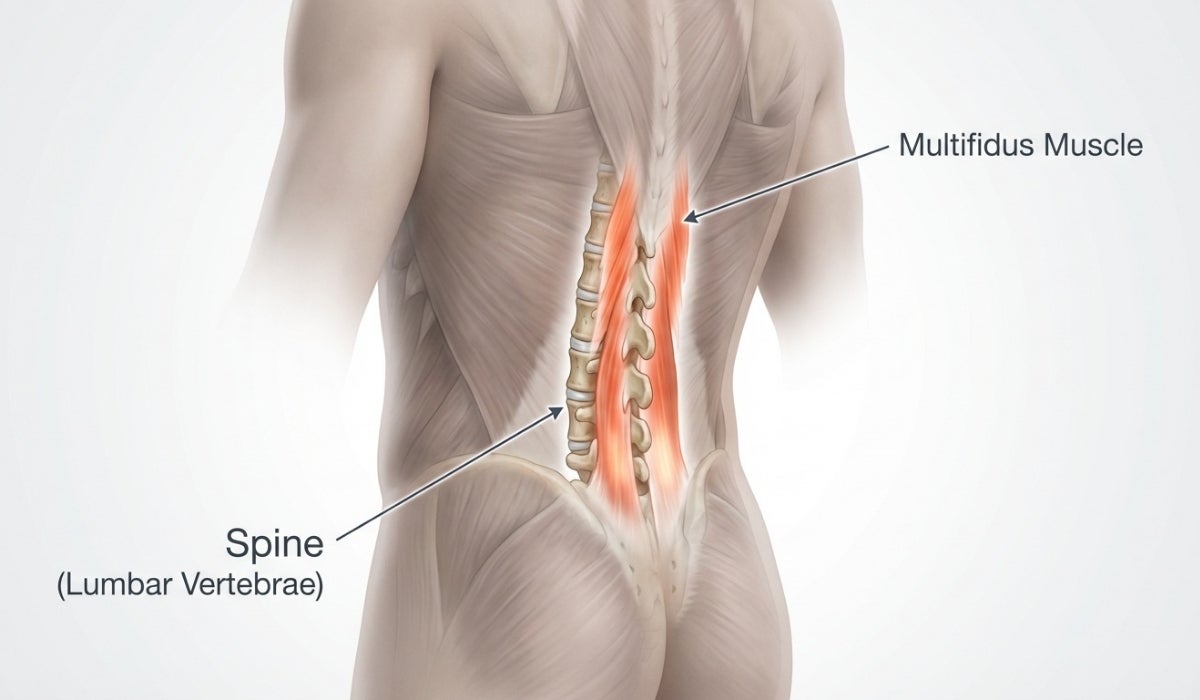
There's a long, deep muscle that runs along both sides of your spine.
It's called the multifidus.
It sits about 3 centimeters beneath the skin of your lower back.
Nobody ever shows you this muscle on a diagram. It's not in the pain clinic pamphlets. Your surgeon doesn't point to it on your MRI.
But it is — without exaggeration — the single most important muscle in your spine.
Here's why.
Your spine is a stack of bones. It does not stand upright on its own. It needs a scaffolding system that holds it together from the inside.
That's the multifidus.
It's your spine's internal brace.
Every time you stand, walk, bend, or turn — this muscle fires thousands of small contractions per minute to hold your vertebrae in alignment.
You don't feel it working. You don't think about it. It just works.
Until one day — it doesn't.
Rebecca told me something that night that made me put my coffee cup down.
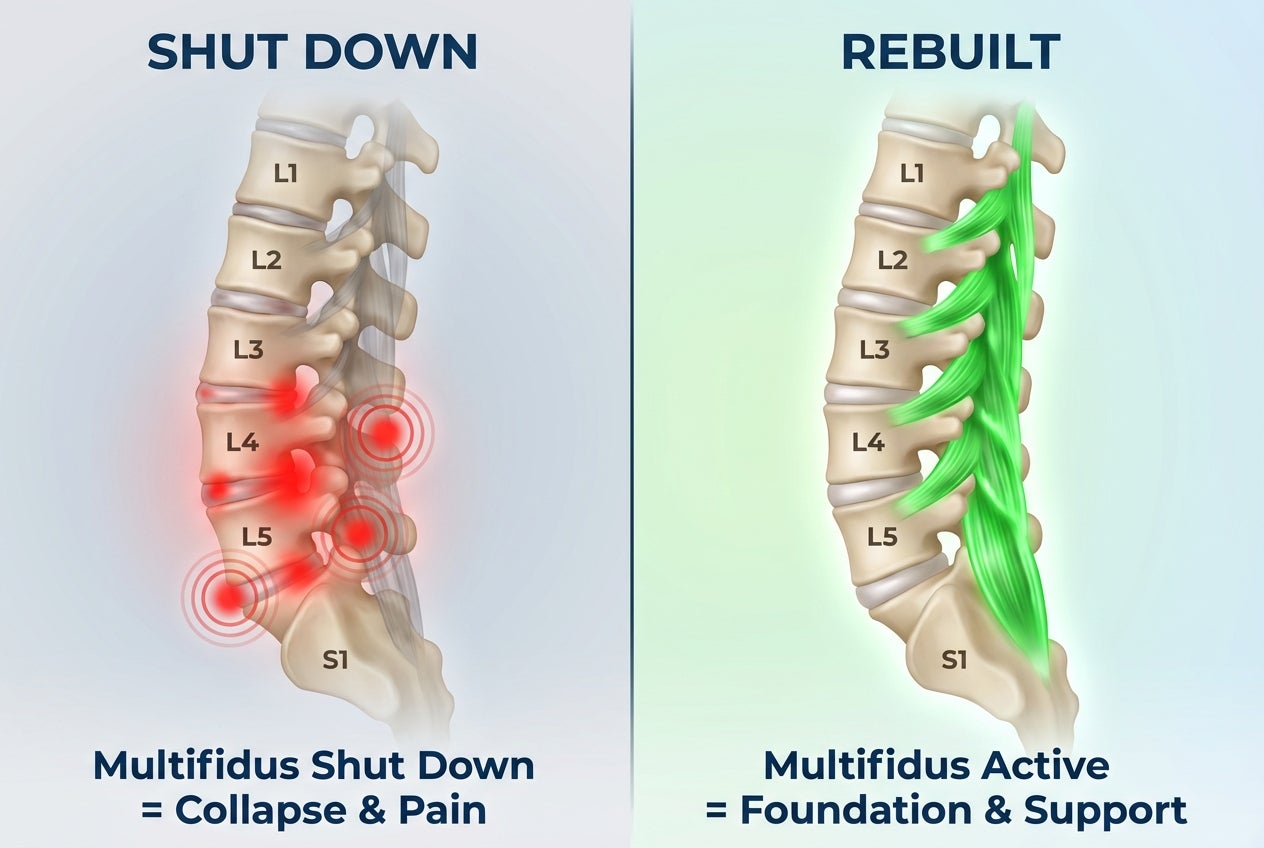
She said: "When your spine got injured, Mom, your brain shut the multifidus off. On purpose."
Here's what she meant:
When the spine experiences trauma — a disc problem, stenosis, a herniation, even the micro-traumas of decades of wear — the brain does something protective.
It cuts the signal to the multifidus.
It tells the muscle: "Stop firing. You're making things worse."
And the muscle obeys.
Within 48 hours of the original injury, the multifidus can lose up to 80% of its function.
It goes silent.
And here is the cruel part — the part that had me sitting at that kitchen table with tears in my eyes:
It does not come back on its own.
Not with rest.
Not with stretching.
Not with physical therapy.
Not with yoga, swimming, pilates, or any "core strengthening" program on earth.
Because the muscle isn't weak.
It's locked.
You can't strengthen something that isn't firing.
There's a name for this, Rebecca told me. Researchers call it Core Muscle Lockout.
And once I heard those two words, everything from the previous 9 years suddenly made sense.
Sitting at that kitchen table at 11 PM on Thanksgiving night, I finally understood.
Physical therapy didn't work — because my multifidus was shut off. They were trying to strengthen a muscle that wasn't firing.
The injections didn't last — because they reduced inflammation for a few weeks, but nothing was addressing the real problem underneath.
The TENS unit did nothing — because TENS reaches 5-8 millimeters deep. My multifidus sits 30-50 millimeters deep. TENS literally could not reach it.
The chiropractic adjustments didn't hold — because without the multifidus holding my vertebrae in place, everything shifted right back.
The surgery failed — because they fixed the bone. They ignored the muscle. I came out of surgery with "perfect hardware placement" and a multifidus that had been shut down for 9 years and had atrophied to the size of a grape.
I wasn't broken.
I wasn't "unresponsive to treatment."
I wasn't one of the unlucky ones whose body just didn't cooperate.
I had a muscle that had been turned off for almost a decade.
And nobody had ever thought to turn it back on.
Rebecca told me there was only one thing on earth that could wake up a multifidus that had been locked for years.
It wasn't more stretching.
It wasn't harder exercise.
It wasn't another surgery.
It was NMES.
Neuromuscular Electrical Stimulation.
Not TENS. She was very clear about this. TENS and NMES are often confused — they're completely different technologies.
TENS blocks pain signals at the surface of the skin. It buzzes. It distracts.
NMES sends targeted electrical signals deep into the muscle tissue — forcing the muscle fibers to contract. Bypassing the brain's "off" signal entirely.
It doesn't ask the multifidus to fire.
It makes it fire.
Contraction after contraction. Forcing the muscle back online. Rebuilding the connection between the brain and the muscle that had been severed for years.
NMES has been used for 40 years in elite sports medicine. It's how Olympic athletes recover from surgery in weeks instead of months. It's how NASA astronauts prevent muscle atrophy in zero gravity.
It was the one thing that could actually break a Core Muscle Lockout.
But until recently, you could only access it inside expensive sports clinics at $300 per session.
Then Rebecca told me about a device that had been quietly changing this.
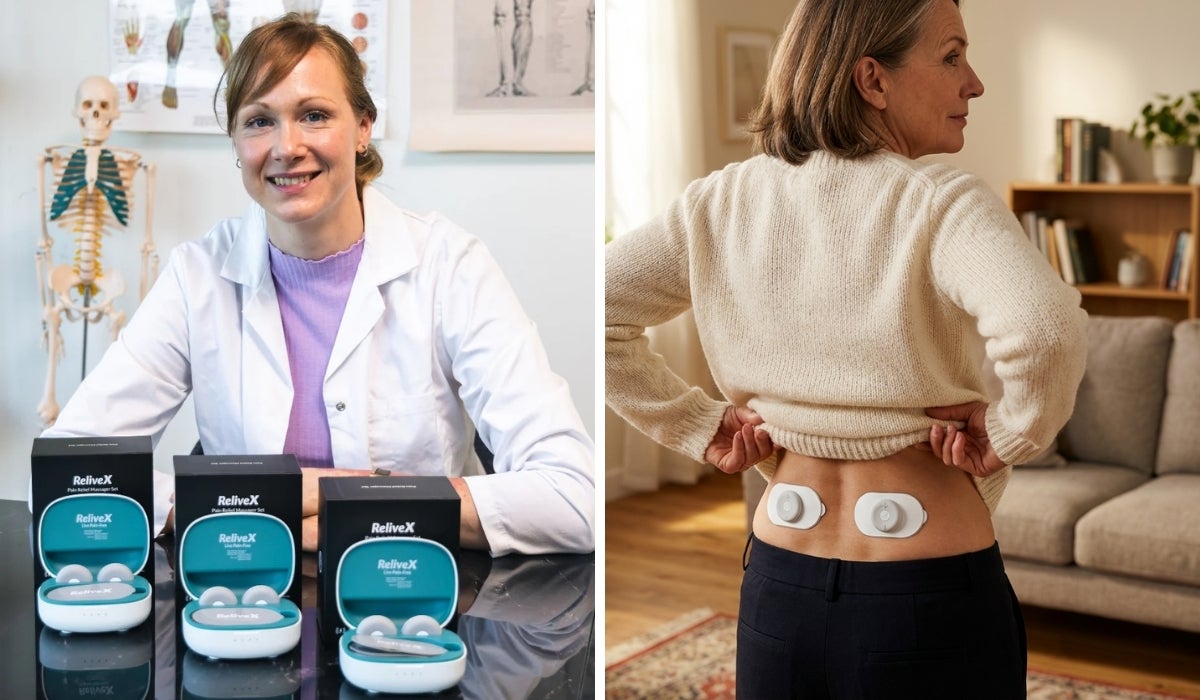
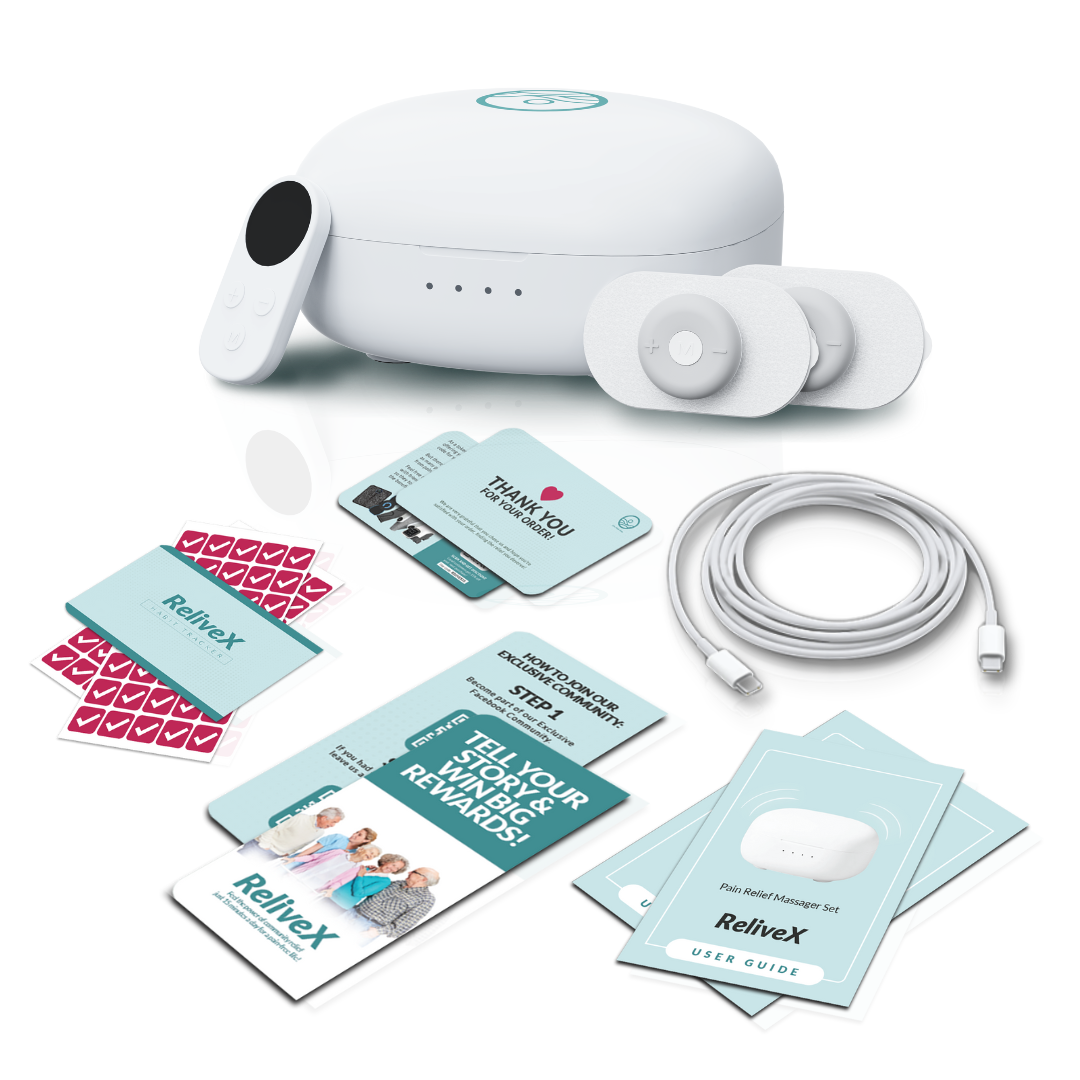
It's called the ReliveX Massage Set.
It's the first at-home NMES device specifically calibrated to target the multifidus at the exact depth it needs — 30 to 50 millimeters — to break a Core Muscle Lockout.
But here's what makes it different from every other NMES device on the market.
It doesn't just stimulate the muscle.
It decompresses the spine AND rebuilds the muscle — at the same time.
Rebecca explained the two phases to me:
Phase A: Decompression. The electrical pulses trigger gentle, rhythmic contractions that pull the vertebrae apart. Creating space. Lifting the pressure off the discs and nerves. It mimics what a clinical decompression table does — except from the inside out.
Phase B: Re-Education. While Phase A is creating space, Phase B is forcing the multifidus to fire. Contraction after contraction. Over 30 days, the neural pathway between brain and muscle rebuilds itself. The brain "remembers" how to use the multifidus. The muscle starts firing on its own again.
15 minutes a day.
That was the whole protocol.
I'd spent — I'd spent — let me see.
Between the surgery, the PT, the chiropractor, the injections, the medications, the braces, the TENS unit, the inversion table, and everything else — I had spent over $47,000 trying to fix my back in 9 years.
And here was this small device, sitting on my daughter-in-law's phone in front of me.
$99.95.
AS SEEN ON

My husband ordered it for me on Black Friday.
It arrived eight days later.
I'll be honest — I opened the box with almost no hope.
I'd been burned so many times. I'd had so many "miracle solutions" turn into drawer ornaments that I couldn't emotionally handle another failure.
I told my husband: "If this doesn't work, I'm going to stop trying."
I meant it.
Day 1: I placed the pads on either side of my lower spine. I started at a low intensity. And I felt something I had not felt in 9 years. A deep pulse. Not on the surface. Inside. It was strange. Almost uncomfortable at first — because I was feeling a muscle that I had essentially forgotten existed. But by minute 10, my lower back felt...open. I don't know another word for it. Like something had let go.
I stood up after the session. Walked to the kitchen. And for a moment — one full minute — I forgot about my back.
I hadn't done that in 9 years.
Week 1: Mornings got easier. The 40-minute warm-up routine I'd built shrank to 15 minutes. I slept through one full night for the first time in 3 years.
Weeks 2-3: I started noticing I wasn't bracing against the kitchen counter while I washed dishes. I'd just been...standing. Without thinking about it.
Week 4: I went to the grocery store without leaning on the cart. Just walking. Like a person.
I cried right there in the produce aisle.
A woman asked if I was okay. I said: "I'm holding my own weight. For the first time in 9 years. I'm just holding my own weight."
She probably thought I was losing my mind.
I'm writing this 14 months after that first session.
Last weekend, I went with my husband to Scotland.
The trip we'd canceled in 2022.
We walked the grounds of Edinburgh Castle. I stood at the top of Arthur's Seat. I hiked — I HIKED, at 68 — through a portion of the West Highland Way.
I use the ReliveX Massage Set for 15 minutes on Monday, Wednesday, and Friday now. That's my maintenance routine.
The rest of the time, my multifidus holds me up.
Like it's supposed to.
Like it did before 2014.

If you're sitting where I was — on the edge of your bed, on the edge of giving up, on the edge of believing this is just your life now —
Whether your surgeon just handed you a fusion pamphlet and you're trying to decide...
Or whether you've already had surgery and you're living with the same pain you had before it...
I'm writing this because I wish someone had sent me this letter in 2022.
Or 2018.
Or 2014.
You haven't failed.
Your body hasn't failed you.
There is a muscle in your back that has been turned off — maybe for years — and no one has ever tried to turn it back on.
You are not broken.
You are locked.
And there is a difference.
✅ Uses NMES (not TENS) — reaches 30-50mm deep to the multifidus
✅ Dual-Action — Phase A Decompression + Phase B Re-Education
✅ 15-minute auto-shutoff (the exact window needed for reactivation)
✅ Wireless, portable, easy to use
✅ FDA-cleared and CE-certified
✅ Designed for spinal stenosis and post-surgical recovery
Today it's available at 50% off — $99.95.
Less than ONE physical therapy session.
Less than ONE month of my old Gabapentin prescription.
Less than the dinner my husband and I bought to celebrate my first pain-free walk.
Use it for 90 days. 15 minutes a day.
If you're not feeling the same thing I felt — the deep pulse, the opening, the muscle coming back online — send it back.
Full refund. No forms. No "store credit." Just email and they'll take care of it.
You have 90 days to know if this is the thing that finally works.
That's more than enough time.
I knew by day 12.
UPDATE: As of today — The demand for ReliveX has increased dramatically and inventory has been flying off the shelves. Order your own for 50% OFF + FAST SHIPPING before it's too late.
Lock in your order while you can to get 50% OFF + FAST SHIPPING
NOTE: This deal is NOT available on Amazon or eBay.


Comments